




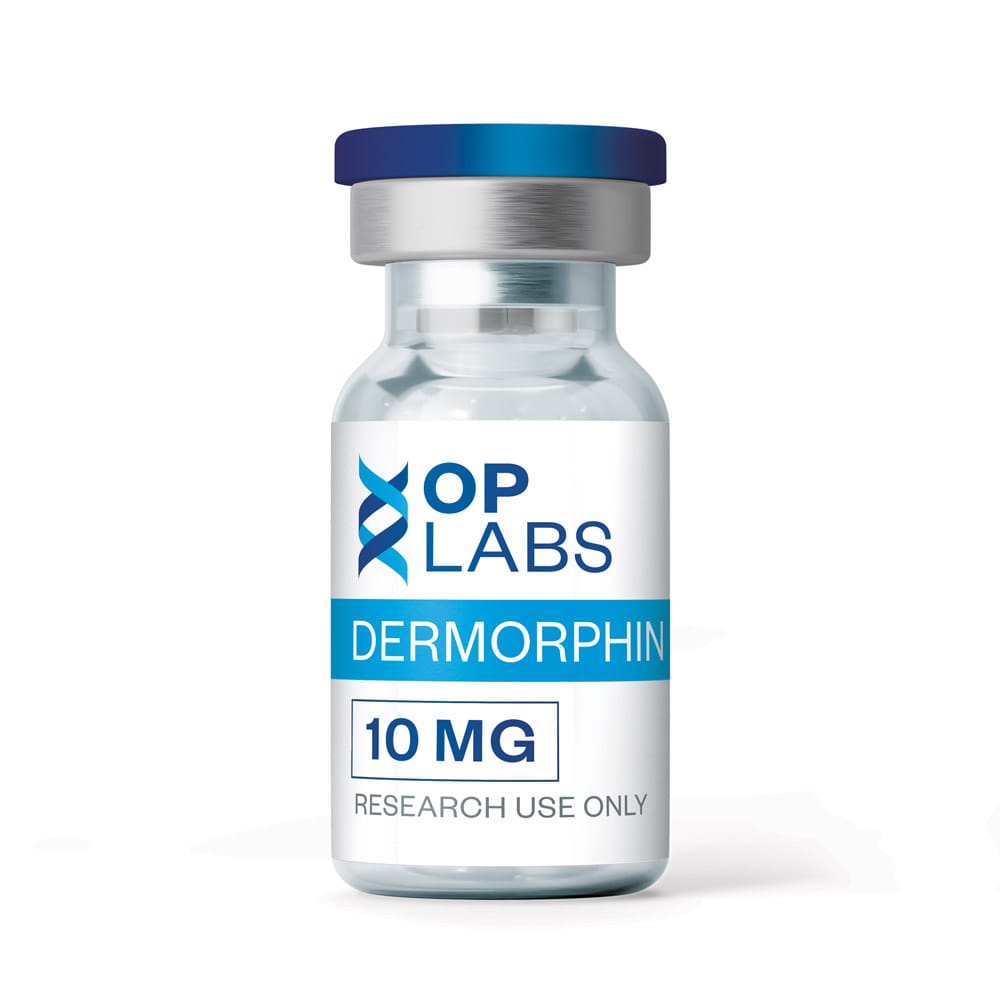



Dermorphin is an extremely potent compound that can cause serious harm or death if handled or used improperly.
There is very limited research on its safety, and it should only be used in controlled laboratory settings by qualified professionals.
- Batch HPLC tested at 99%+ purity.
- Store frozen long term or in fridge when ready to be used.
- Sold for research purposes only.
- Contact us for Wholesale Orders.
Download COA here: Dermorphin COA.pdf
Please note if you have a different Batch ID please contact us for the latest COA.
Dermorphin
Dermorphin is a hepta-peptide first isolated from the skin of South American frogsbelonging to the genus Phyllomedusa.[1] The peptide is a natural opioid that binds as an agonist with high potency and selectivity to mu opioid receptors.[2][3]
Dermorphin is about 30–40 times more potent than morphine, but theoretically may be less likely to produce drug tolerance and addiction due to its high potency.[4]The amino acid sequence of dermorphin is H-Tyr-D-Ala-Phe-Gly-Tyr-Pro-Ser-NH2.
Dermorphin is not found in humans or other mammals and similar D–amino acidpeptides have only been found in bacteria, amphibians, and molluscs.[5]
Dermorphin appears to be made in these through an unusual posttranslational modification carried out by an amino acid isomerase.[6] This unusual process is needed because the D-alanine in this peptide is not among the 20 amino acids coded for in the genetic code and thus the peptide cannot be synthesized in the usual way from the encodings in the genome of an organism.
References
-
Melchiorri P, Negri L (1996). “The dermorphin peptide family”. Gen. Pharmacol. 27(7): 1099–107. doi:10.1016/0306-3623(95)02149-3. PMID 8981054.
-
Amiche M, Delfour A, Nicolas P (1998). “Opioid peptides from frog skin”. D-Amino Acids in Sequences of Secreted Peptides of Multicellular Organisms. Vol. 85. pp. 57–71. doi:10.1007/978-3-0348-8837-0_4 (inactive 1 November 2024). ISBN 978-3-0348-9794-5. PMID 9949868.
{{cite book}}:|journal=ignored (help) -
Erspamer V, Melchiorri P, Falconieri-Erspamer G, et al. (1989). “Deltorphins: a family of naturally occurring peptides with high affinity and selectivity for delta opioid binding sites”. Proc. Natl. Acad. Sci. U.S.A. 86 (13): 5188–92. Bibcode:1989PNAS…86.5188E. doi:10.1073/pnas.86.13.5188. PMC 297583. PMID 2544892.
-
Broccardo M, Erspamer V, Falconieri Erspamer G, et al. (1981). “Pharmacological data on dermorphins, a new class of potent opioid peptides from amphibian skin”. Br. J. Pharmacol. 73 (3): 625–31. doi:10.1111/j.1476-5381.1981.tb16797.x. PMC 2071698. PMID 7195758.
-
Kreil G (15 April 1994). “Peptides containing a D-amino acid from frogs and molluscs”. J. Biol. Chem. 269 (15): 10967–70. doi:10.1016/S0021-9258(19)78075-2. PMID 8157620.
-
Heck SD, Faraci WS, Kelbaugh PR, Saccomano NA, Thadeio PF, Volkmann RA (1996). “Posttranslational amino acid epimerization: enzyme-catalyzed isomerization of amino acid residues in peptide chains”. Proc. Natl. Acad. Sci. U.S.A. 93 (9): 4036–9. Bibcode:1996PNAS…93.4036H. doi:10.1073/pnas.93.9.4036. PMC 39482. PMID 8633012.
Keywords: Dermorphin.
Reviews
There are no reviews yet.